Your questions answered
Ask a question
Previous questions asked
Devolution is the transfer of powers and funding from national to local government. Local government reorganisation is about how the powers and funding that sit with local government are organised between councils.
Consultations are a crucial part of the local government reorganisation (LGR) process. They allow government and local councils to engage with communities, employees, and other stakeholders to gather input and ensure that reorganisation meets local needs and priorities.
A public survey ran last year and closed on 28 September 2025. The feedback was analysed and it helped shape our proposals for how councils in Lancashire could be organised in the future.
The government will hold a further consultation in February 2026. This will give you another chance to share your views and influence the future structure of local government.
Shared services will be considered where they are most appropriate, such as for specialist teams. Final arrangements depend on agreements between future councils. Examples could include emergency planning and resilience teams.
Following clarification from the Minister for Local Government, a single unitary for Lancashire would not be compatible with current devolution plans. For powers and funding to be devolved from central government, a combined county authority is required, and our understanding is that a CCA requires more than one local authority member. Therefore, more than one unitary would be required to support devolution arrangements.
The aim of new unitary authorities is to improve service delivery and efficiency. This will likely lead to a review of operations and any existing duplication across Lancashire, in order to create a more efficient and effective local government structure. However, they may also create new roles and responsibilities, offering fresh career paths and growth opportunities.
Overall, while changes are inevitable, we are focused on ensuring that future reorganisation benefits both our employees and our community.
There are no current plans for a council-wide scheme. Most staff will most likely transfer under a form of TUPE if LGR proceeds. Decisions will be communicated transparently.
There is ongoing engagement with councils like Cumbria and North Yorkshire. Lessons from recent reorganisations are being applied to improve implementation.
The survey is a collaborative effort across the 15 councils of Lancashire. A government consultation is expected in early 2026, which will allow more detailed feedback.
Different councils used the shared data to develop a range of options. As a result, five different proposals were submitted to government:
|
Option |
Geography |
|
Two Unitary Authorities |
Unitary One: Blackpool, Fylde, Wyre, Lancaster, Preston, Ribble Valley |
|
Unitary Two: West Lancashire, South Ribble, Chorley, Blackburn with Darwen, Hyndburn, Rossendale, Burnley, Pendle |
|
|
Three Unitary Authorities |
Unitary One: Preston, South Ribble, Chorley, West Lancashire |
|
Unitary Two: Blackpool, Fylde, Wyre, Lancaster |
|
|
Unitary Three: Ribble Valley, Blackburn with Darwen, Hyndburn, Rossendale, Burnley, Pendle |
|
|
Four Unitary Authorities – Option A |
Unitary One: South Ribble, Chorley, West Lancashire |
|
Unitary Two: Blackpool, Fylde, Wyre |
|
|
Unitary Three: Preston, Ribble Valley, Lancaster |
|
|
Unitary Four: Blackburn with Darwen, Hyndburn, Rossendale, Burnley, Pendle |
|
|
Four Unitary Authorities – Option B |
Unitary One: Lancaster, part of rural Wyre, part of northern Ribble Valley |
|
Unitary Two: Blackpool, part of western Wyre, Fylde, Preston |
|
|
Unitary Three: South Ribble, West Lancashire, Chorley |
|
|
Unitary Four: Part of Southern Ribble Valley, Blackburn with Darwen, Hyndburn, Rossendale, Burnley, Pendle |
|
|
Five Unitary Authorities |
Unitary One: South Ribble, West Lancashire, Chorley |
|
Unitary Two: Blackburn with Darwen, Hyndburn, Ribble Valley |
|
|
Unitary Three: Pendle, Burnley, Rossendale |
|
|
Unitary Four: Preston, Fylde, Blackpool |
|
|
Unitary Five: Wyre, Lancaster |
After carefully reviewing all the options using data and evidence, the county council developed a proposal to create two new unitary councils – one for the north and one for the south – broadly divided by the River Ribble, as shown on the map below.
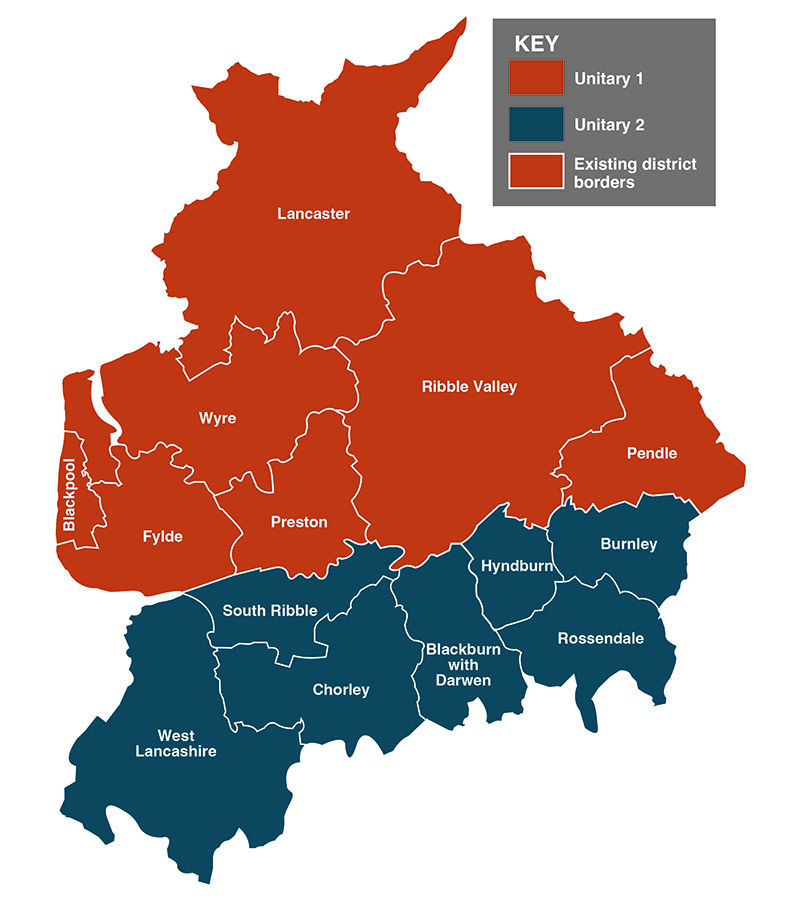
We consider the two-unitary model to be the strongest option because it:
- Creates fair and balanced councils with the right resources and service levels.
- Strengthens financial resilience and offers the best value for money, with projected savings of £391 million over five years, creating the opportunity to invest in communities.
- Protects services for vulnerable people and provides the most financial flexibility to support valued local services.
- Has the capacity to drive economic and housing growth that benefits local communities.
- Enables a smooth and efficient transition, minimising disruption and delivering benefits quickly.
- Supports better joint working with public services like health, fire and police and avoids holding back the voluntary, community and private sectors.
- Reflects what residents and staff have told us matters most to them.
Questions raised at the Question and Answer sessions
How likely is this to happen?
It’s very likely to happen. Lancashire has been through this before, but this time it’s part of a national plan for England. The government has said it wants to bring in local government reorganisation before this Parliament ends, with the new arrangements in place by 2029. We were asked to submit proposals in November, and the government has now begun its consultation. Every message from ministers says it will go ahead, so we need to prepare on that basis.
If there is a snap election or change of government, will this still happen?
A snap election is unexpected although not impossible. Different political parties have different views, including some scepticism, but based on the messages we've had so far, LGR is still expected to go ahead. Once new councils are set up, reversing the process, would likely prove to be difficult and expensive.
Will government listen to consultation feedback?
Ministers will make their decision by looking at all the evidence and the feedback from the consultation, and they’ll be obliged to consider everything carefully and fairly.
Will there be redundancies or voluntary redundancies?
It’s too early to know. Most staff are expected to move over to the new council(s) doing the same job. Any reductions are likely to affect mainly senior roles and other roles where there is overlap. Existing vacancies could help reduce the impact.
Will we have to reapply for our jobs?
The aim is to make the transfer safe and smooth. We think the most senior roles might be appointed before vesting day (when they formally take over from existing councils), and wider restructuring is likely to take place later once the new councils are up and running.
What happens to pay, annual leave and terms and conditions?
Staff would likely transfer under a form of TUPE (Transfer of Undertakings Protection of Employment). Continuous service and contractual terms move with you on day one. Any harmonisation would be for new councils to decide later through consultation.
Will people in the same role but different councils be paid differently?
While we don't know for sure at the moment, we expect on day one, yes this could happen as we expect people to transfer on existing terms. The new councils would then look at terms and conditions to ensure all staff would then be on the same terms and conditions.
How will staff be allocated to the new councils?
The county council will lead disaggregation. It will consider business need and personal circumstances. It will not be done in a dark room and will be developed with unions and later shadow councils.
What if I don’t want the post I am allocated?
That will depend on the detailed scheme created with unions. Redeployment processes will be included.
Will unions be involved?
Yes. Under TUPE, new employers must issue measures letters and consult. Union engagement continues throughout.
What is TUPE?
TUPE protects employees during organisational transfers. It preserves continuous service and terms and requires consultation. It prevents the poor practice that existed before TUPE.
Will the Chief Executive be leaving?
No. The intention is to stay through to the end of LGR.
Will there be a freeze on structures?
Not currently. The council still has to run services. As vesting day approaches, this may be reviewed.
Why is the preference for two unitaries instead of three, four or five, and why not one unitary?
The proposal for two, argues that it will allow for balance and reduced overheads. A single unitary cannot currently be created because a unitary cannot share the same geography as a combined authority under devolution rules. Lancashire has noted interest if policy changes.
Will parish and town councils get more responsibilities?
Possibly. Government expects strong neighbourhood arrangements. This detail will be for the new councils.
Will some services be shared between new councils?
Some may be especially transitional ones or where it makes sense to avoid dilution of specialist teams. Long-term sharing depends on the new councils’ choices.
What is the timeline?
Proposals submitted in November. Consultation now underway. Decision expected in summer. Shadow elections in 2027. New councils go live in April 2028.
Will there be one or two elections?
One. The 2027 election appoints shadow councillors who continue after vesting day.
What does the shadow year mean for staff?
Shadow councils set up the new organisation but have limited authority over existing councils. County council business continues until March 2028.
How long will transition last after vesting (when they formally take over from existing councils) day?
It is up to the new councils. Some may move quickly, others more slowly to maintain safe and legal operation.
Who pays for LGR and branding?
Current government policy is that costs are met locally. Lancashire has asked government to contribute and awaits a response.
What happens to County Hall?
It's too early to say. It would depend on the final structure and needs of the new councils.
How will IT systems be handled?
A pan-Lancashire digital workstream is mapping all systems. A safety-first approach will apply, possibly with temporary parallel systems. Harmonisation comes later.
What about children in care across Lancashire, Blackpool and Blackburn with Darwen?
Work will take place with the other upper-tier authorities. The aim is continuity and a coherent offer. Children’s voices will inform plans.
Will community mental health services be affected?
NHS partners are involved. Fewer councils may simplify integration. No major concerns have been raised so far.
What will happen to non-statutory pan-Lancashire services?
Nothing automatically stops on day one. Future decisions are for the new councils. Transitional sharing may happen.
How does the Combined County Authority fit in?
The CCA remains important. Government will want to ensure the new councils interface properly with it. Some services may be delivered collaboratively depending on legislation and design.
What impact will it have on my pension?
This should not have an impact on pensions as it will remain on the Local Government Pension Scheme.
Will the budgets for all councils remain the same when the changes happen?
The total money across Lancashire stays the same, but it will be shared out differently. The cost of setting up the new councils must be covered locally, although the changes should create savings over time. We’ve asked the government to contribute towards these costs and are waiting for a response.
Is there a cap on the number of councillors per unitary?
There is guidance that the number of councillors each unitary can have should be up to about 100, and depending on that, the size of the area they cover could vary
How fixed is the date?
Government has repeated the date of the new councils as being the end of this parliament.
There are lots of assets across the county, both in district council, existing unitaries and the county council. What will happen to them?
Once we know the model, there will need to be a process to decide where each asset will sit. This includes places like County Hall and business parks that serve the whole county. We’ll need to work with the new councils to agree this, and there may be the option to sell some assets. All assets will transfer to the new councils.
How will having new council affect current recruitment?
For the moment there will be no changes. As with any uncertainty it could affect people applying to roles, but we will monitor and see how this impacts us. Once we know what the model for Lancashire is, all councils will begin to think about roles are needed.
People often find change difficult. What measures will be put in place to support staff wellbeing and welfare?
We recognise that this period brings uncertainty, and we know change can be difficult. That’s why staff wellbeing and support are top of the agenda. We will share information as soon as we are able, including what the changes might mean for you.
Some of the early work will involve setting out the theoretical process of what needs to happen. Once we know which unitaries we’re moving forward with, we can start planning which teams will move and begin countywide planning with staff involved throughout.
In some areas, we may be able to start conversations even before we have all the answers, for example with new organisations about specialist roles or possible shared functions hosted by a single council. We’ll keep you updated as this develops.
More complex work, such as disaggregating staff, will take longer. Depending on how the new councils are set up, some teams will move across, unions will need to be involved, and a clear timeline will be created. We’ll also provide detailed Q&A information on workforce changes, including what it means for roles, pay, and terms and conditions.
A lot of this will take months, and we may not know where every team will sit until next summer. But we will keep you informed throughout. We’re also speaking to other councils going through the same process to learn from their experience, and the LGA website is a useful source of guidance.